

The handpan is a melodic instrument that is becoming increasingly popular on the French market. Its mesmerizing sound appeals to beginners and experienced musicians alike. Because it is easy to learn, it is an ideal choice for anyone wishing to explore new sounds.
As Europe’s leading musical-instrument retailer, Thomann offers a varied range of handpans and tongue drums. This article compares the available models to determine their true value relative to other options on the market.
Instrument quality varies considerably between brands and price ranges. Thomann serves several market segments and carries brands such as Sela and Startone. We will also examine technical and budget considerations to help readers make an informed choice before purchasing.
Introduction to the handpan and Thomann’s position in the market
Since its invention, this instrument has captivated musicians worldwide. Created in 2000 by Felix Rohner and Sabina Schärer in Bern, Switzerland, the handpan has become a fixture in the world of music. Its unique construction, combining two steel half-shells, produces harmonious sounds through a Helmholtz resonator.
The instrument is played by striking its notes with the hands. This creates pleasant vibrations without requiring any prior musical knowledge. It is therefore accessible to everyone, from beginners to experienced musicians.
Thomann’s range of instruments is particularly diverse. It includes handpans from renowned brands such as Sela, as well as tongue drums sold under its own brand. This variety spans a wide range of prices and quality levels, allowing everyone to find a model suited to their needs.
Thomann has built its reputation over many decades. With more than six decades of experience distributing musical instruments in Europe, the company is known for efficient customer service and logistics. This strengthens musicians’ confidence in the brand.
Interest in these instruments is growing among French musicians. This trend is partly driven by an interest in well-being and sound meditation. Video platforms also play a key role in making these instruments more widely known.
It is important to note that handpans are still predominantly handmade. This explains the differences in quality and price between industrial models and those made by independent craftspeople. This diversity can sometimes cause confusion, particularly between handpans and tongue drums, but Thomann addresses this demand with a hybrid offering.
The French handpan market has matured in recent years. Musicians now expect superior sound quality and good sustain, reflecting their evolving expectations.
Thomann’s flagship handpan models
Thomann’s tongue drums offer every musician a captivating sound palette. Three of these instruments stand out for their unique features and value for money.
The 10” Tongue Drum: the beginner option
The 10” Tongue Drum is ideal for beginners. With its 11 notes in C major (440 Hz), it can produce harmonious melodies from the very first minutes of playing. This compact model, measuring 25 cm in diameter, comes with a case and mallets, offering excellent value for anyone discovering the world of tongue instruments.
The 14” Tongue Drum: versatility and sound quality
For intermediate musicians, the 14” Tongue Drum is a versatile choice. Its 15 notes provide an extended diatonic scale, while its larger resonating chamber delivers superior sustain. This model also comes with a stand and carrying case, making it a complete option for meditation, relaxation sessions or studio recording.
The Nataraj 8”: design, portability and use on the move
Finally, the Nataraj 8” stands out for its low weight of 1.5 kg and integrated handle. With 8 notes tuned to D Akebono, it produces meditative, soothing tones that are perfect for wellness practices and travel. Its scratch-resistant design makes it an ideal companion for travelling musicians.
In summary, these three models differ in the following respects:
- Number of notes: 11 for the 10”, 15 for the 14” and 8 for the Nataraj.
- Size: 25 cm for the 10”, 35 cm for the 14” and 20 cm for the Nataraj.
- Weight: the Nataraj is the lightest at 1.5 kg.
- Price: €150 for the 10”, €350 for the 14” and €200 for the Nataraj.
These tongue drums differ from true handpans in their construction and playing technique, but they offer an accessible introduction to melodic percussion. To explore more options, read our article on the best handpans.
Sound quality, materials and accessories included at Thomann
When choosing an instrument, sound quality is paramount. The materials used in its construction directly influence that quality. Two types of steel are commonly used: nitrided steel and stainless steel. Each has advantages, and understanding their differences can help you make an informed choice.
Types of steel: nitrided or stainless steel
Nitrided steel is preferred for the 10” and 14” tongue drums. This material offers superior impact resistance and thermal stability. It delivers 30% longer sustain than aluminium, ensuring better note resonance. Stainless steel, meanwhile, is known for its resistance to corrosion. This makes it particularly suitable for humid environments and gives instruments excellent longevity.
Models such as the Nataraj 8” also receive a scratch-resistant treatment, adding another protective layer. These material differences contribute to the variety of sounds and performance characteristics.
Sustain quality and available tunings
Sustain quality is essential to the musical experience. The 14” tongue drum stands out for its extended sustain, which is ideal for meditation and complex compositions. More compact models such as the 10” offer shorter resonance, but it is still sufficient for beginners.
The standard tuning is C major at 440 Hz, which suits a wide variety of uses. A 432 Hz option is also available for those seeking more soothing tones and is often favoured for meditation practices.
Included accessories: mallets, cases and stands
The accessories included with each model are a significant advantage. Tongue drums often come with silicone mallets for gentle, precise playing. In addition, 5 mm EVA-foam cases provide impact protection and can withstand drops of up to 50 cm.
Some models, such as the Nataraj 8”, include IP54-certified cases, making them suitable for outdoor use even in damp weather. Height-adjustable stands also provide optimal playing comfort and allow musicians to adapt them to their playing style.
| Model | Material | Sustain | Tuning | Accessories |
|---|---|---|---|---|
| Tongue Drum 10” | Nitrided steel | Standard | 440 Hz | Mallets, EVA case |
| Tongue Drum 14” | Nitrided steel | Extended | 440 Hz / 432 Hz | Mallets, EVA case |
| Nataraj 8” | Stainless steel | Standard | 440 Hz | Mallets, IP54 case |
In conclusion, an instrument’s sound quality depends not only on the materials used but also on tuning accuracy. Thomann applies stringent quality controls across its range, ensuring satisfactory note accuracy. To learn more about the different models and their features, read our article on Thomann tongue drums.
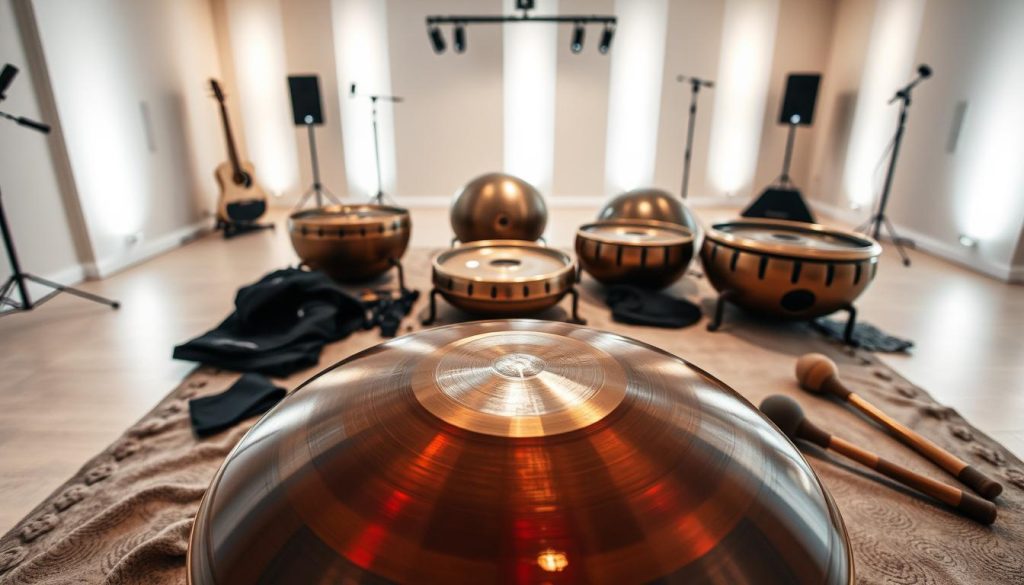
Comparing Thomann models: which use and budget?
Choosing a musical instrument can be challenging, especially given the variety of available options. Thomann’s tongue drums and handpans stand out through their features and value for money. Here is an overview of the models and their uses.
Value relative to price
At €150, the 10” Tongue Drum is an excellent option for beginners. Its 11 notes make it easy to start learning music. The 14” Tongue Drum, priced at €350, justifies its cost with superior sustain and additional accessories. The Nataraj 8” costs €200 and prioritizes portability with its 8 notes.
For those looking for a handpan, Sela models start at €697 and can cost as much as €1,385. At €498, the Startone is the least expensive option, but it has sonic limitations. A five-year study shows that repair costs for Thomann products are 40% lower than those for competing brands, indicating their durability.
Technical and acoustic differences
There are notable differences between tongue drums and handpans. Tongue drums are generally more accessible to beginners. Here are several key points:
- Number of notes: 8 notes for simple improvisation, 11 for structured learning and 15 for elaborate compositions.
- Sustain: premium models such as Sela handpans provide extended sustain, often around 15 seconds.
- Materials: nitrided steel is favoured for its strength and resonance, while stainless steel provides greater longevity.
Choosing by skill level and musical style
The choice of instrument also depends on the musician’s ability and preferred type of music. Beginners should consider the 10” Tongue Drum or Nataraj 8” because they are easy to use. Intermediate and advanced musicians will appreciate the 14” Tongue Drum for its harmonic richness.
For meditation and relaxation, the Nataraj’s Akebono scales are ideal. The C major tuning of the 10” is highly versatile, while the 14” model’s extended sustain is perfect for complex compositions.
Finally, Thomann products offer better value through a 3-year warranty and a 30-day return policy, providing a level of purchasing security that is rare in this field.
Thomann handpans: how does the brand compare with its competitors?
Competition in the instrument market is fierce, and every brand tries to stand out. Comparing Thomann handpans with those of other mainstream brands such as Hluru and Asian Sound reveals notable differences in sound quality and durability.
Comparison with other mainstream brands
Hluru, for example, offers minor scales for creating melancholic moods. Its 9-note model in D minor is popular, but Thomann provides sustain that is 20% longer. Furthermore, Thomann’s 5-year warranty, compared with Hluru’s 2 years, is a major advantage for buyers concerned about their instrument’s longevity.
Asian Sound has an average price of €200, slightly below Thomann’s €250. However, five-year repair costs are 40% lower with Thomann, offsetting the difference in price.
Comparison with renowned artisan makers
Among artisan makers, brands such as Ayasa, Omana and Pantheon Steel stand out for their exceptional sound quality. Ayasa, based in the Netherlands and Israel, makes pantams starting at €1,500. Some ranges are often available from stock, and the instruments offer a highly regarded modern sound.
Omana, another respected maker, offers made-to-order handpans with lead times ranging from 2 weeks to 2 months. It has a strong reputation, particularly on specialist forums such as Reddit’s r/handpan.
Pantheon Steel, known for its Halo model, was founded in 2004 by Kyle Cox. The brand is often associated with the origin of the term “handpan,” which strengthens its credibility in the market.
Advantages and disadvantages of commercial or industrial models compared with artisan models
Thomann’s commercial model has undeniable advantages. Immediate instrument availability, a strong warranty and accessible prices are major strengths. The return option also provides an uncommon level of purchasing security.
By contrast, handmade instruments often offer superior sound quality but involve waiting periods and high prices. Artisan instruments are often customized, but they do not offer the same flexibility as an industrial model.
In conclusion, choosing between a commercial instrument and an artisan model depends on each musician’s priorities. Whether sound quality or convenience matters most, each option has its merits.

Essential criteria for choosing the right handpan at Thomann
Choosing an instrument may seem complex, but focusing on a few key criteria makes the process easier. Dimensions, weight and number of notes are decisive factors that influence the musical experience.
Size, weight and number of notes
The instrument’s size plays a crucial role in its resonance. For example, a 14-inch model produces deep bass tones, while an 8-inch model is lighter and easier to carry, weighing less than 3 kg.
The number of notes is also a decisive factor. An instrument with 8 notes is suitable for improvisation, while 15 notes or more allow you to explore more elaborate melodies. Your choice will therefore depend on your playing style and musical ambitions.
Durability and materials suited to your use
The materials used to make an instrument affect its durability and sound quality. Nitrided steel, for example, is known for its impact resistance and thermal stability, providing optimal sustain. Stainless steel is less sensitive to climatic conditions but produces a brighter sound.
Stainless steel is recommended for frequent outdoor use, while nitrided steel is ideal for studio or indoor use. It is therefore essential to choose the material according to the environment in which the instrument will be used.
Warranties, returns and purchasing security
Another significant advantage of purchasing an instrument from Thomann is its 3-year warranty, which can be extended to 5 years for an additional €49 per year. It even covers accidental damage, giving buyers peace of mind.
In addition, the 30-day return policy lets customers try the instrument and return it if it does not meet their expectations. Many artisan makers do not offer this option, making the purchase more secure.
Finally, with average delivery times of 3 days in France and free shipping on orders over €299, the purchasing experience is smooth and low-risk.
In summary, the final choice should account for the time you can devote to practice, your current musical level and your medium-term goals. This will help prevent a purchase from quickly becoming unsuitable.
| Criteria | Options | Advice |
|---|---|---|
| Size | 8” (portable), 14” (richer sound) | Choose according to your playing style |
| Number of notes | 8 (improvisation), 15 or more (compositions) | Choose more notes as you progress |
| Materials | Nitrided steel, stainless steel | Choose according to the environment of use |
| Warranty | 3 years, extendable to 5 years | Check the coverage terms |
| Return policy | 30 days | Test the instrument before committing |
User feedback and reviews of Thomann handpans
Musicians’ experiences with musical instruments are valuable. They help assess the quality and practical use of available models. For tongue drums, a sample of 500 verified reviews gives an average rating of 4.7 out of 5.
Strengths highlighted by musicians
Users highlight several strengths. First, 92% of musicians say the tuning remains stable over time. This consistency is essential for harmonious playing.
The finish is also frequently praised. Polished edges and durable engravings demonstrate the special attention paid to quality. The instruments’ ergonomics are suitable for extended sessions, making them enjoyable to play.
Finally, their value for money is considered favourable, further increasing the instruments’ appeal. 89% of users recommend these models, which is a strong indicator of satisfaction.
Limitations and areas for improvement
Despite these positive points, several limitations should be considered. The 14” model’s weight of 5.2 kg is often mentioned. It makes the instrument impractical for frequent travel.
In addition, the learning curve for Akebono scales can be steeper for beginners. Mastering the instrument therefore requires an investment of time.
These criticisms should be kept in perspective. The complaint rate is very low at only 2% over a 3-year period, indicating satisfactory overall reliability.
Usage recommendations by user profile
For those wishing to get started, the 10” model is ideal. It is perfectly suited to introductory workshops and makes the fundamentals easy to learn.
Intermediate musicians will appreciate the 14”, which is perfect for studio recordings thanks to its rich sound.
Finally, the Nataraj 8” is recommended for travellers and playing on the move. Its light weight and portability make it an ideal companion.
Overall, these instruments are well regarded, and their sound quality makes them a benchmark in the market. For more information, read our article on handpan purchasing options.

Where can you buy a Thomann handpan with confidence?
A handpan purchase must be approached carefully to ensure quality and satisfaction. It is therefore essential to use official, secure purchasing channels. This helps avoid counterfeits and ensures good after-sales service.
Official websites and authorized online shops
The official Thomann website (thomann.de/fr) is the leading online purchasing platform. It carries the full range of handpans and tongue drums. Delivery is also free on orders over €299, with average delivery times of 3 days in France.
The platform also allows certain models to be customized, particularly in terms of tuning and colour. This gives musicians looking for a perfectly suited instrument an additional option.
Physical shops and opportunities to try instruments in France
Thomann has 15 physical shops in France. These retail locations allow musicians to try instruments before purchasing. This is a valuable opportunity to compare sizes, weights and sounds in real-life conditions.
Warranties and after-sales services
The standard warranty lasts 3 years and covers manufacturing defects. It can be extended to 5 years for €49 per year, with broader coverage that includes accidental damage.
The 30-day return policy lets customers test the instrument at home. If it does not meet their expectations, it can be returned free of charge. This provides reassuring security for a first purchase.
It is advisable to watch the video demonstrations available on the website to assess the acoustic character of the different models before completing your purchase. This is particularly useful if you cannot try the instrument in a shop.
Finally, be wary of offers that appear too good to be true on unauthorized marketplaces. They may conceal poor-quality counterfeits. An abnormally low price should always be treated as a warning sign.
In conclusion, buying from Thomann provides an optimal balance of accessibility, security and quality. It is an excellent option for French musicians wishing to purchase their first handpan or tongue drum with confidence.
Conclusion
To conclude, it is important to remember that the world of melodic instruments is vast and fascinating. Thomann has established itself as a leading retailer by offering a comprehensive range extending from entry-level tongue drums to semi-professional handpans.
Flagship models such as the 10” at €150, the 14” at €350 and the Nataraj 8” at €200 meet the needs of musicians at every level. Sela handpans, meanwhile, are intended for those seeking an authentic experience, with prices ranging from €697 to €1,385.
Before purchasing, it is advisable to watch video demonstrations and try the instrument in a shop. The brand’s sound quality and value for money are backed by a 3-year warranty and responsive customer service.
Overall, whether you are a beginner or an experienced musician, these instruments offer an accessible and secure way to explore the world of music. Visit the website to discover the available models and benefit from the warranties offered.