

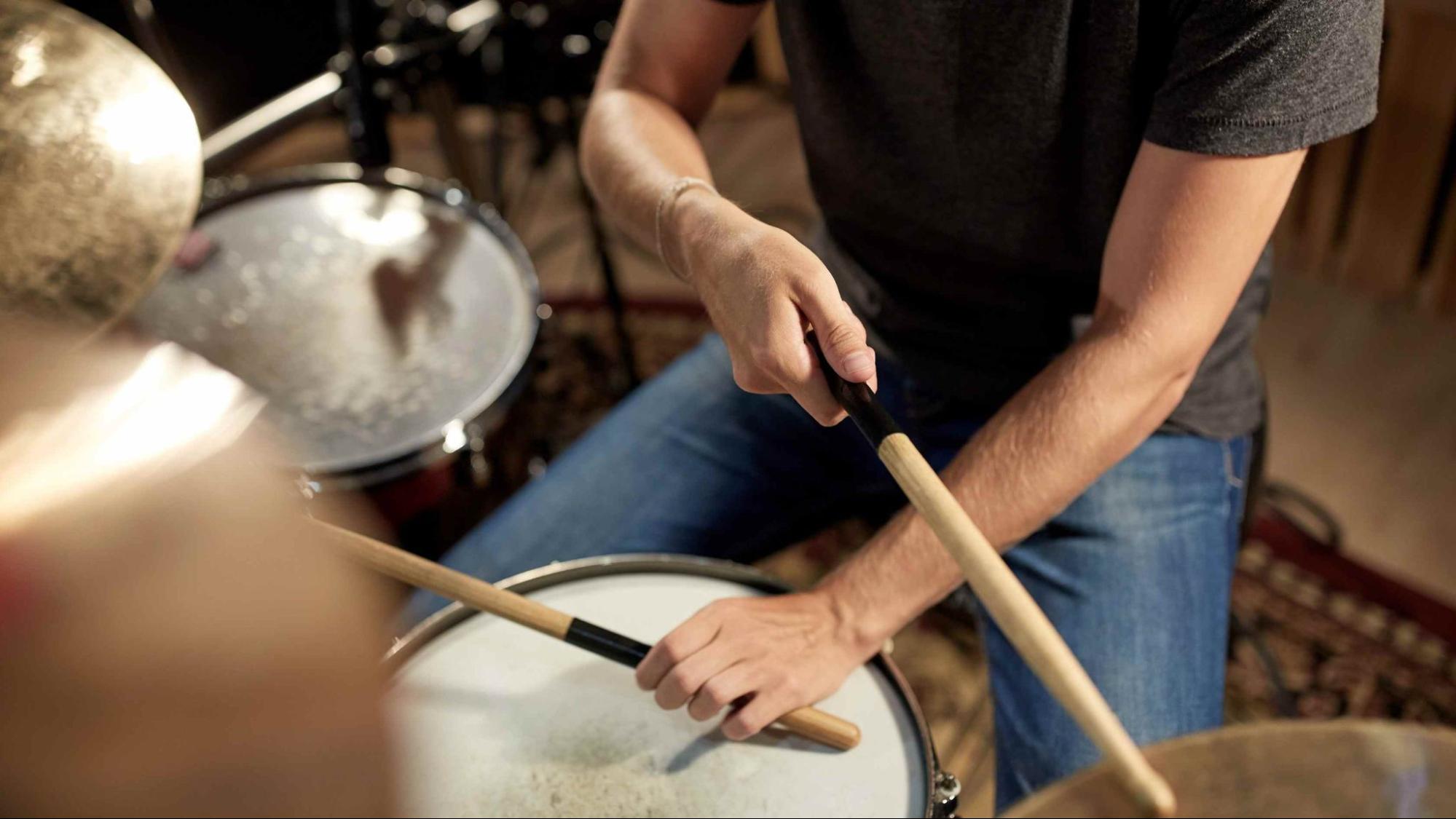
Some drummers improve quickly after just a few months, while others stagnate for several years. This difference is not always primarily due to talent. To improve on the drums, you need a learning method and regular practice. This demanding instrument requires a sense of rhythm, listening skills, coordination, and stamina. Discover 10 practical tips for improving effectively on the drums.
1. Adopt the Right Posture and Setup
You can only make good progress on the drums if your setup is suitable. Poor posture can:
- Cause muscle tension;
- Slow down your playing;
- Make your playing less fluid.
Ideally, your drum throne should be adjusted to a height that allows your thighs to slope slightly downward. Your feet should be able to reach the hi-hat and bass drum pedals with relative ease.
Your back should remain straight but relaxed, and your shoulders loose. Your wrists should stay mobile and never tense up. With good posture, you will play more accurately, tire less easily, and gain speed as well. In the long term, you will be able to practice for longer and more effectively.
2. Structure Your Learning with a Drum Teacher
Although it is possible to learn on your own, this approach has its limits. You are more likely to develop bad habits and fail to see real progress. You will also find it harder to identify your mistakes. Getting guidance will save you a great deal of time.
Contacting a private tutor through a platform such as Superprof is a practical way to improve more quickly. You can access a personalized program featuring exercises suited to your level, as well as immediate feedback. The teacher will adapt to your pace of learning.
3. Prioritize Consistency over Session Length
Mastering the drums relies on muscle memory. It is therefore better to play a little every day than to practice for long periods irregularly. For example, you could schedule daily sessions of 20 to 30 minutes.
This consistency helps you develop automatic responses and improve your coordination. It is also the best way to avoid losing your bearings between sessions that are too far apart. Even on days when motivation is particularly low, a short session will maintain your momentum.
4. Always Practice with a Metronome
A metronome is a small device that marks the beat while you play a piece. It is very useful for developing a strong sense of tempo. Many beginner drummers mistakenly neglect it. Playing in time is just as important as playing the right notes.
To practice with a metronome, start with simple exercises on the snare drum or hi-hat at a slow tempo. Then gradually add the bass drum and toms. This will help improve your stability, consistency, and accuracy. These qualities are essential when playing with other musicians.
5. Start Slowly to Make Lasting Progress
Many drummers want to be able to play fast. However, taking the time to practice is the best way to master each movement and avoid inaccuracies. At a slow tempo, the brain absorbs sequences far more effectively. Your movements become more controlled and precise.
Once you have mastered the rhythm at a slow tempo, increasing the speed comes naturally. This gradual approach is far more effective than forcing yourself to play faster at the expense of accuracy.
6. Break Down Complex Rhythms and Patterns
When you need to play a difficult rhythm, the most effective solution is to break it down. You can work on the hands alone first, then the feet, before gradually coordinating them.
This breakdown method reduces the mental load and makes it easier to develop limb independence. Each element is understood and mastered individually before being combined with the others. This speeds up the overall learning process.
7. Develop Independence between Your Hands and Feet
Playing the drums involves using all four limbs simultaneously, so developing their independence is essential. To do this, start with simple exercises, such as playing a steady rhythm on the hi-hat with variations on the bass drum.
Just a few minutes of daily independence exercises can significantly improve your coordination. In the long term, your playing will become more fluid and musical.
8. Vary Musical Styles to Enrich Your Playing
Avoid restricting yourself to a single style, as this could slow your progress. Each musical genre helps develop specific skills. For example:
- Jazz develops finesse and independence;
- Rock builds power and consistency;
- Funk improves your groove.
Explore different styles to broaden your rhythmic range and become a more versatile drummer. This variety also helps maintain motivation.
9. Record Yourself Regularly for Perspective
Listening to yourself play is an excellent way to improve. Listening to your recordings allows you to analyze your tempo and dynamics. What you do not notice while playing usually becomes obvious when you listen back.
This self-assessment helps you identify areas for improvement more precisely and adjust your practice sessions accordingly.
10. Set Clear, Achievable Goals
Progress is more motivating when it is tied to specific goals, so make sure you set some. For example, you might aim to play an entire song, master a groove, or reach a certain tempo with the metronome. Having milestones like these gives your practice sessions direction.
Keep in mind that your goals should be realistic and progressive. With each milestone you reach, you will gain confidence and feel more motivated to keep practicing.