
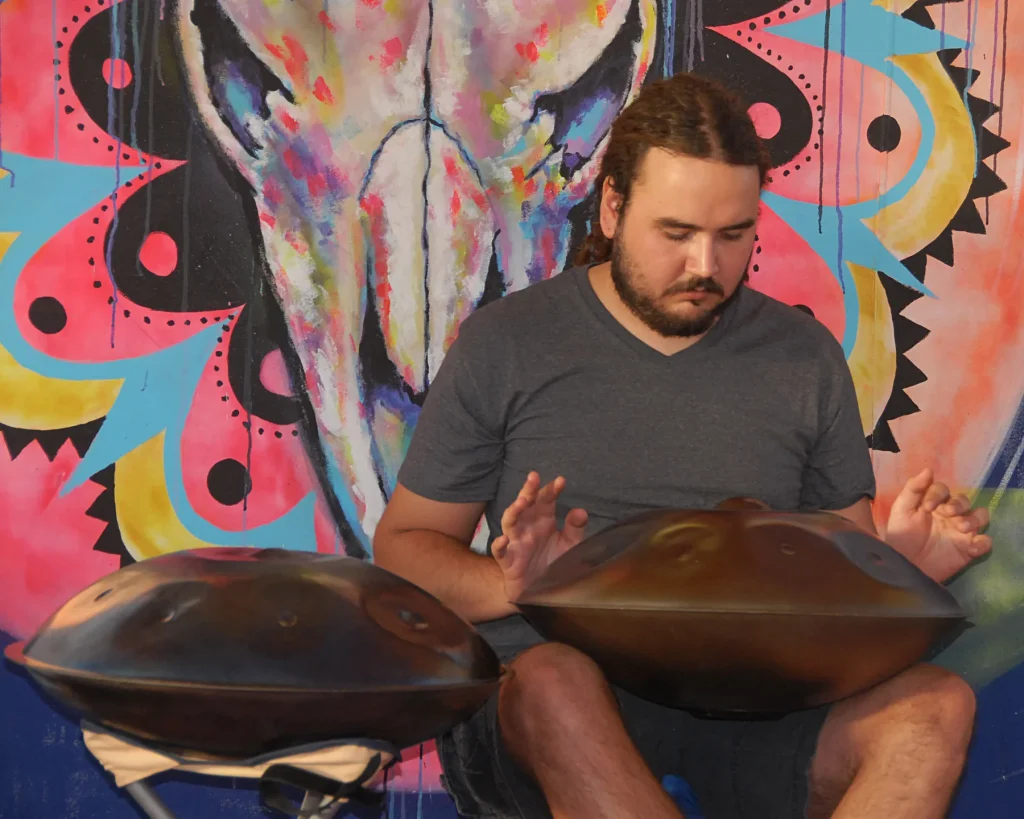
The handpan is a melodic and percussive instrument that captivates listeners with its enchanting sounds. Accessible and intuitive, it lets you create music from the very first moments of playing. Every note belongs to a single scale, ensuring natural harmony and making improvisation easier, even for beginners.
This guide answers essential questions: which model should you choose? What budget should you plan for? Can you learn on your own? Each answer will help you get started under the best possible conditions.
As you read this article, you will discover the origins of this instrument, its playing techniques, and much more. Whether you are a beginner or an enthusiast, the handpan offers a unique sensory experience that enriches your approach to music.
1. Discovering the handpan: a unique and captivating instrument
This fascinating instrument, often called a pantam, has captured the attention of music lovers. It grew out of the evolution of the steel drums of Trinidad & Tobago. Popularized in the early 2000s, it came into being through the innovation of PANArt, the company that created the first model, the Hang.
Since then, numerous craftspeople known as makers have expanded this world. They have refined manufacturing techniques, allowing models and scales to become more diverse. This evolution has turned the handpan into a genuine worldwide musical phenomenon.
The origin and evolution of the handpan
The handpan has a rich history rooted in musical culture. It represents a fusion of tradition and modernity. Exploring its origins reveals a fascinating journey shaped by passion and creativity.
The global handpan community in France
The global handpan community is a vibrant network of enthusiasts. This community is particularly active in France. Groups such as French Handpan Connection on Facebook provide a space where new players can exchange ideas and find support.
These gatherings allow people to share advice, discover scales, and help one another as they take their first steps. Kindness and mutual support lie at the heart of this community.
Distinctive sound and melodic qualities
The sounds produced by the handpan are both percussive and melodic. Lightly striking the tuned steel shells with the fingers creates a unique harmony. Each note produces a fundamental, an octave, and a fifth, resulting in a captivating timbre.
This intuitive quality allows anyone to express themselves without any prior musical knowledge. As they play, musicians can explore a rich sonic world in which music becomes a form of meditation.
In short, discovering the handpan means immersing yourself in a world where every note invites personal expression. All of this contributes to its growing appeal, which reaches thousands of people around the world.
| Elements | Details |
|---|---|
| Origin | Evolution of the steel drums of Trinidad & Tobago |
| Creation | PANArt, first model: Hang |
| Community | Vibrant network of enthusiasts |
| Sound characteristics | Unique harmony, percussive and melodic sound |
2. Understanding handpan scales and notes
A handpan’s scales and notes are essential to understanding this unique instrument. Unlike chromatic instruments such as the piano, the handpan uses specific scales. Each model has a single scale that determines its sonic identity.
What is a handpan scale?
A scale is a group of notes that harmonize with one another. It defines the key and musical atmosphere you can create. Every handpan is tuned to a single scale, making it distinctive. The selected notes therefore form a harmonious whole.
- Diatonic instrument: unlike chromatic instruments, the handpan is diatonic or modal, meaning that all its notes belong to the same harmonic family.
- Musical notation: English note names are used: A, B, C, D, E, F, and G. This convention is crucial to understanding scales.
- Note arrangement: the central note, called the ding, is surrounded by notes arranged in a circle. Each note produces a fundamental, an octave, and a fifth, creating a rich sound.
Musical notation and note arrangement
Each handpan note has three components. When a note is struck, it resonates at three different frequencies. This contributes to the characteristic sonic richness of this musical instrument.
It is important to note that the lowest note, the ding, determines the instrument’s key. The second-lowest note defines its main mode. Understanding this structure is therefore essential for improvising and composing.
Many different scales are available. Some are very common, such as D Kurd, while others are more exotic, such as Hijaz or Ragadesh. Each one offers different playing possibilities and emotions.
In conclusion, mastering a handpan’s scales and notes is fundamental for any musician. It not only makes purposeful playing possible but also opens the door to a rich and varied musical world.
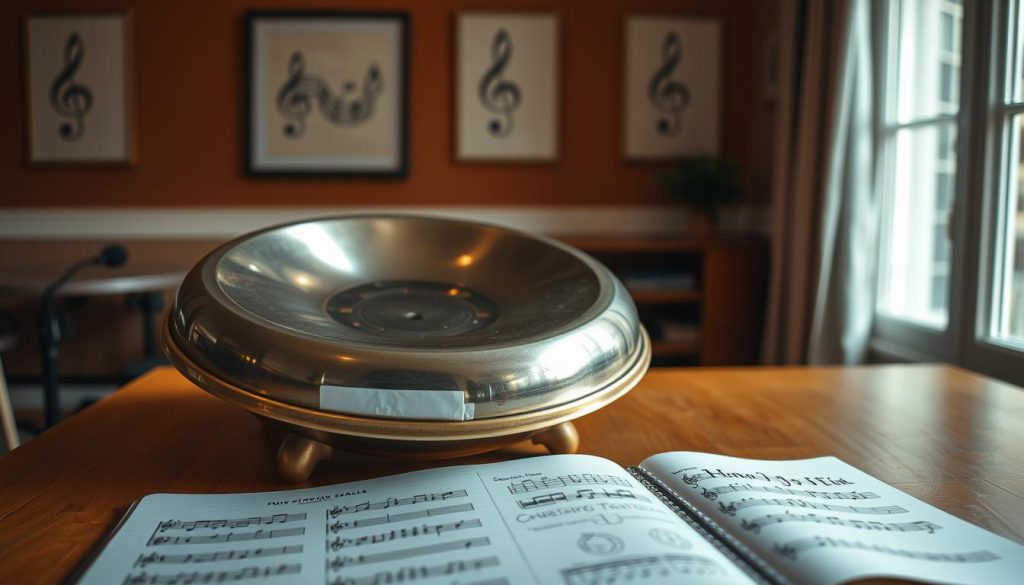
3. Handpan: a complete guide to discovering this instrument – choosing the ideal scale
Choosing the ideal handpan scale is an essential step for any musician. To begin, it is important to become familiar with the different sounds available. Listening to several scales online helps develop your musical ear.
Listening to and recognizing different scales
Start by exploring demonstration videos. Artists such as David Kuckhermann, Shellopan, Adrian Portia, and Jeremy Di Nieri give captivating performances. Take time to note the scales that move you, along with their names and notes.
The emotions and styles associated with scales
Each scale has a unique tonal color. Some evoke joyful emotions, while others may feel melancholy or mystical. Here are a few associated musical styles:
- Bluesy: evokes deep, introspective feelings.
- Jazzy: adds a touch of improvisation and freedom.
- Celtic: recalls the landscapes and culture of Ireland.
- Asian: creates a meditative and soothing atmosphere.
Tips for gradually refining your choice
It is best not to search for the perfect scale immediately. Begin by selecting the ones you like. Set them aside, then return to them later for more attentive listening.
One useful tip is to watch several videos of the same scale played by different musicians. This will help you appreciate its tonal nuances and variations.
Finally, nothing replaces direct experience. If possible, try different models at makers’ workshops. This will help you feel their vibrations and make an informed choice.
4. Number of notes: its influence on sound and playing
The number of notes on a handpan has a significant impact on its sound and playing experience. There are two ways to count the notes: some include the ding, while others do not. A handpan may therefore be described as having 8 notes or 7 + 1. The “X + 1” notation, in which X represents the number of notes arranged around the circle, is recommended to clarify the configuration with the maker.
“X + 1” notation and the role of the ding
The ding is the instrument’s lowest central note. It serves as a tonal anchor and influences the tuning of all the other notes. Understanding this notation is crucial to avoiding confusion when making a purchase.
Advantages and disadvantages of different configurations
A larger number of notes provides more harmonic possibilities, allowing you to explore a richer palette of sounds. However, many notes can also increase the risk of imperfect tuning. High notes may lack volume, and interference may occur between neighboring notes.
Conversely, an instrument with fewer notes often has better overall sound quality. However, it may limit compositional possibilities, and the player may experience a degree of monotony over time.
How many notes should a first handpan have?
For a first purchase, it is advisable to choose a model with at least 8 notes around the circle, excluding the ding, and no more than 9. This configuration offers the best balance between musical potential and sound quality. Experienced makers can produce quality instruments with as many as 10 + 1 notes, often making any differences imperceptible.
Ultimately, the number of notes influences both playing technique and musical style. A handpan with more notes opens up more complex playing possibilities, while a model with fewer notes encourages a more meditative and intuitive approach.
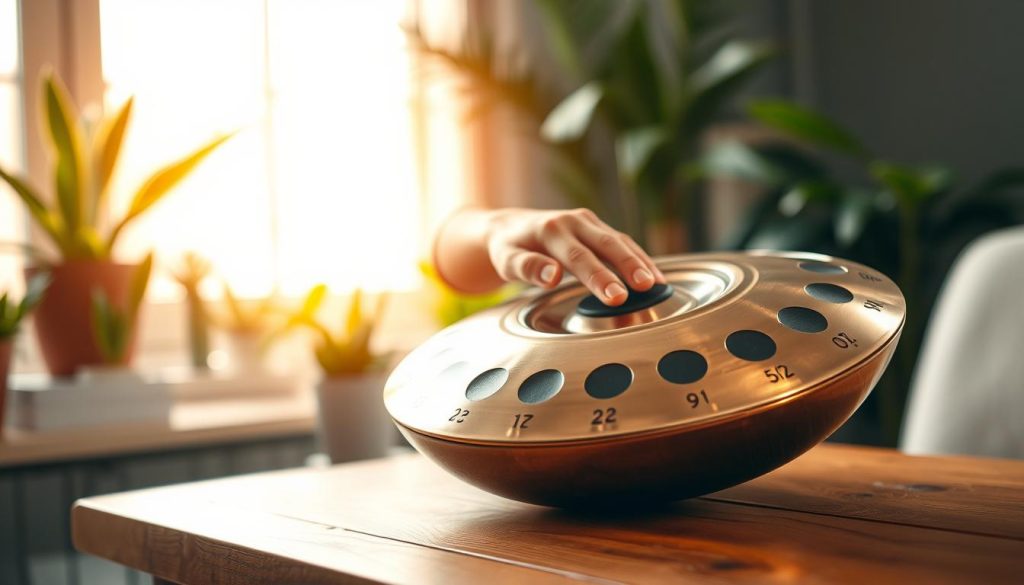
5. Handpan construction and quality
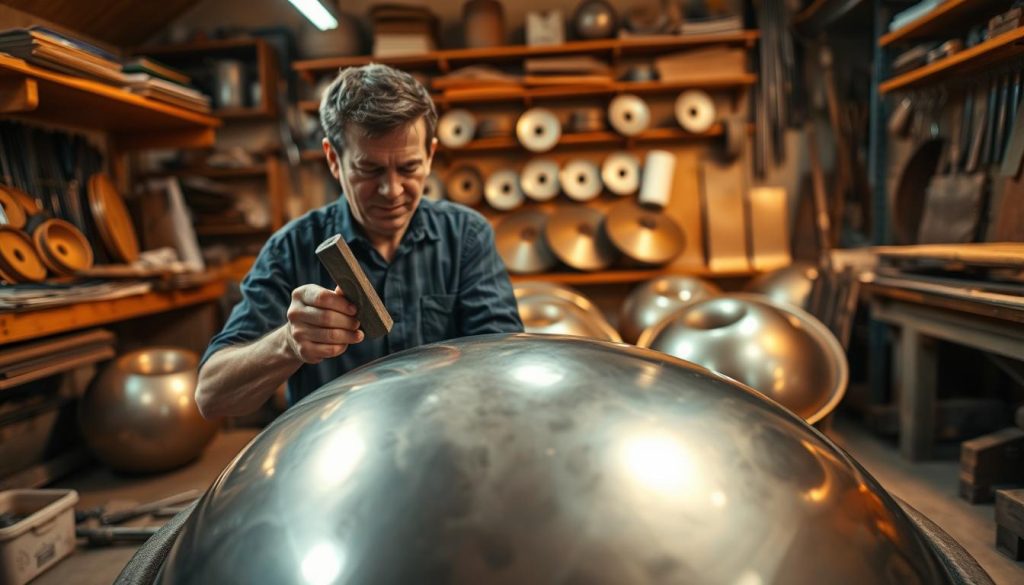
A handpan’s sound quality depends heavily on how it is made. This complex process takes place in three stages: designing the object, tuning it to bring the instrument to life, and refining its timbre.
Materials: nitrided steel or stainless steel
Two main materials are used to make handpans: nitrided steel and stainless steel. Nitrided steel, the original material, offers a wide playing dynamic and a sound that gradually fades like a waterfall. Stainless steel, particularly 430/441/4xx stainless steel, produces a more compressed sound with very long sustain, making it ideal for low-pitched instruments and outdoor playing.
The artisanal manufacturing process
Making a handpan is an art. Every stage is crucial:
- Design: the shell is shaped to give the instrument its form.
- Tuning: performed by hand with a hammer, this process can take several hours for each note.
- Finishing: this stage determines the unique tonal character of each handpan.
Key criteria for assessing tuning, timbre, and finishing
Several criteria should be considered when assessing the quality of a handpan:
| Criteria | Details |
|---|---|
| Tuning | Each note must produce an accurate fundamental, octave, and fifth. |
| Sustain | Good sustain should be balanced, neither too short nor too long. |
| Dynamics | The ability to produce sounds at different volumes without distortion. |
| Balance | All notes should have a consistent timbre. |
| Coupling | Subtle interactions between notes that create a rich sound. |
| Finishing | Pleasant surfaces, protection against rust, and no sharp edges. |
All these elements help prospective buyers recognize a quality handpan. A maker’s level of expertise is revealed through these different criteria, which are essential to making an informed choice.
6. Prices and tips for buying your first handpan
Buying a handpan can seem intimidating, especially for newcomers. However, understanding the price ranges and available options makes choosing much easier. A good instrument should be both accessible and high-quality.
Price ranges and expected quality
A handpan made by a craftsperson generally costs between €1,000 and €2,500. This price reflects the meticulous work and expertise required to create a well-tuned instrument. Investing in an artisan-made handpan provides superior harmonic richness and durability.
Entry-level models are also available at more affordable prices. These instruments can offer beginners an appealing introduction. However, they often have limitations, such as a less rich sound and potentially less stable tuning.
Choosing between a maker, an established brand, and an entry-level instrument
When choosing your instrument, several options are available:
- Craftspeople: artisan-made handpans offer exceptional sound quality, but at a higher price.
- Established brands: brands such as Yatao offer well-made instruments for beginners.
- Second-hand instruments: buying a used handpan can be a good solution for anyone seeking good value for money.
Where and how can you buy safely?
For a safe purchase, favor identifiable makers who are recognized by the community. Avoid dropshipping sites that promise deals that seem too good to be true. They may conceal poor-quality instruments.
It is essential to research the seller’s reputation. Read reviews from other people who have already purchased from them. Do not hesitate to ask questions about the manufacturing process and the warranties provided.
When buying second-hand, check the state of the tuning and make sure there is no rust. Ensure that the instrument has not sustained damage that could affect its sound in the long term.
In conclusion, the choice of your first handpan should be carefully considered. It is better to wait and save for a quality instrument than to rush into buying a cheap model. Treat this purchase as an investment in a lasting musical experience, because a good, well-maintained instrument will give you years of enjoyment.
| Type of handpan | Price range | Sound quality |
|---|---|---|
| Artisan-made | €1,000–€2,500 | Excellent, rich, and long-lasting |
| Established brands | €500–€1,500 | Good and suitable for beginners |
| Entry-level | €200–€500 | Limited, with a risk of unstable tuning |
7. Learning to play the handpan: a beginner’s guide
Learning to play such an instrument is a rewarding adventure. Its intuitive nature makes it particularly accessible. You do not need any prior knowledge of music notation or complex theory. You can simply begin and start creating melodies right away.
Can you learn on your own?
Yes, it is entirely possible to learn on your own. This instrument was designed to be easy to approach. Beginners can make rapid progress with a gradual method. Within a few weeks, you can develop your musicality and compose your own melodies.
The basics of touch and rhythm
The handpan is very sensitive. Learning to play lightly and accurately is crucial. Good touch technique produces a clear sound and distinct notes. By playing gently, you can create a smooth and pleasing performance.
Rhythm is also fundamental. Even with a limited number of notes, a steady rhythm can bring your music to life. Understanding the pulse and rhythmic subdivisions is essential to maintaining consistent playing over time.
Recommended resources and courses
Several resources are available to help you learn. Courses such as Easy Handpan offer a progressive method. You can also find free beginner workshops and online tutorials.
Begin with simple exercises, such as playing one note in time. Then try alternating between two notes. This will help you explore the different areas of the instrument with both hands.
It is important to practice regularly, even in short sessions. Consistency matters more than duration. This will allow you to develop muscle memory and refine your touch.
Finally, do not try to play quickly or imitate experienced musicians right away. Take time to explore your instrument, listen to the sounds it produces, and develop your own musical sensitivity.
In summary, for successful learning, focus on a light touch, develop a solid sense of rhythm, and use educational resources suited to your level. This will help you progress in a structured and motivating way.

8. Essential techniques for smooth, expressive playing
Mastering playing techniques is crucial to getting the most out of this instrument. A light touch and accuracy are the foundations of a rewarding musical experience. When played carefully, each note can resonate clearly and expressively.
A light touch and accuracy
The light-touch technique is essential. It involves learning to brush the notes with the pads of your fingers instead of hitting them. A flexible, bouncing movement allows the note to vibrate freely, producing a pure, clear sound.
Each finger should land precisely in the center of the note’s dimple. This ensures the best possible resonance. Regular practice and close attention to the quality of the sound produced will turn this movement into a reflex.
- Practical exercises: play each note slowly while focusing on sound quality. Vary the intensity of your strike to explore the instrument’s dynamics. Also work on coordination between both hands to achieve smooth, even playing.
Understanding the pulse and rhythmic subdivisions
The pulse is the heartbeat of the music being played. It sets the tempo and structures the performance. It is essential to feel it internally before you begin playing. This provides a solid rhythmic foundation.
Rhythmic subdivisions, which allow you to create more complex patterns, are also important. Understanding how to divide a beat into two, three, or four equal parts opens a world of possibilities for enriching your playing.
- Mastering subdivisions: this allows you to progress from simple playing to more elaborate performances. You can create syncopation, offbeats, and rhythmic patterns that add dimension and expressiveness to melodies.
Use a metronome to develop rhythmic stability. Start with slow exercises and focus on consistency. Gradually increase the speed while maintaining accurate touch and sound quality.
Remaining relaxed is also crucial. Relaxed hands and fingers allow for a more accurate touch and a more beautiful sound. Muscular tension interferes with smooth playing and can affect the sound quality of the notes produced.
By exploring the connection between touch and expressiveness, you will be able to convey emotions through your playing. Vary the nuances, intensity, and articulation to bring your music to life.
In summary, mastering these essential techniques will allow you to express yourself freely. You will develop playing that is smooth, accurate, and deeply expressive, regardless of your starting level.
9. Popular scales and recommended styles for beginners
Exploring popular scales is essential for any player who wants to become familiar with the handpan. The choice of scale directly influences the musical experience and personal expression. Here is an overview of the most common scales that are ideal for beginners.
An introduction to the most common scales
Scales such as D Kurd, AmaRa, Integral, Magic Voyage, AnnaZiska, Equinox, and Pygmy are particularly recommended. These minor scales are very easy to play and make it possible to create beautiful melodies from the very beginning.
The D Kurd scale is the most popular because of its balance and versatility. It is tuned in D, with a D ding, allowing players to explore a variety of musical moods. The AmaRa scale, meanwhile, is available in C# or D and stands out for its rich sounds, which are perfect for beginners.
Minor or major scales: what is the emotional impact?
Minor scales, such as those mentioned above, encourage melancholy and introspective moods. They are perfectly suited to the handpan’s hypnotic and meditative character. Major scales, by contrast, bring brightness and joy that can also enrich your playing.
Greek modes such as the Aeolian and Dorian modes are also interesting to explore. The Aeolian mode, or natural minor, is gentle and melancholy, while the brighter Dorian mode is often used in varied styles such as funk, jazz, and Celtic music.
Avoiding the pitfalls of overly distinctive scales
It is important to be cautious with highly distinctive scales such as Hijaz, Romanian, Ragadesh, or Saladin. Although captivating, they can confine your playing to a single tonal color, thereby limiting the versatility of your practice.
For example, with a scale such as Ragadesh, you might feel that every note evokes a particular atmosphere, which can become frustrating over time. It is therefore advisable to favor more common scales such as D Kurd or AmaRa, which allow greater freedom of expression.
In conclusion, choosing the right scale is essential for beginners. Listen carefully to recordings of each scale and try them if possible. This will help you feel the differences in touch and tone. Remember that a popular scale makes it easier to meet and join jam sessions with other players, making your musical experience even more rewarding.
10. Conclusion: find the scale that resonates with you
Choosing the right scale is an exciting adventure. Every note and every sound has its own color and can evoke different emotions. What resonates with one person may not move another. It is all subjective. Take time to explore the different scales and discover the ones that speak to you.
The handpan is an intuitive instrument that is accessible to everyone. You do not need advanced technical knowledge to start playing and creating melodies. This article has guided you through the essential stages, from discovering scales to understanding notes.
Trust your instincts. Let your emotions guide your choice. Music is a personal journey, and every player has their own story to tell. Explore, listen, and savor every moment of your musical experience.
Finally, remember that this choice marks the beginning of a wonderful adventure. With time and practice, your relationship with this instrument will deepen. Free resources and online courses are waiting to support you as you learn.