
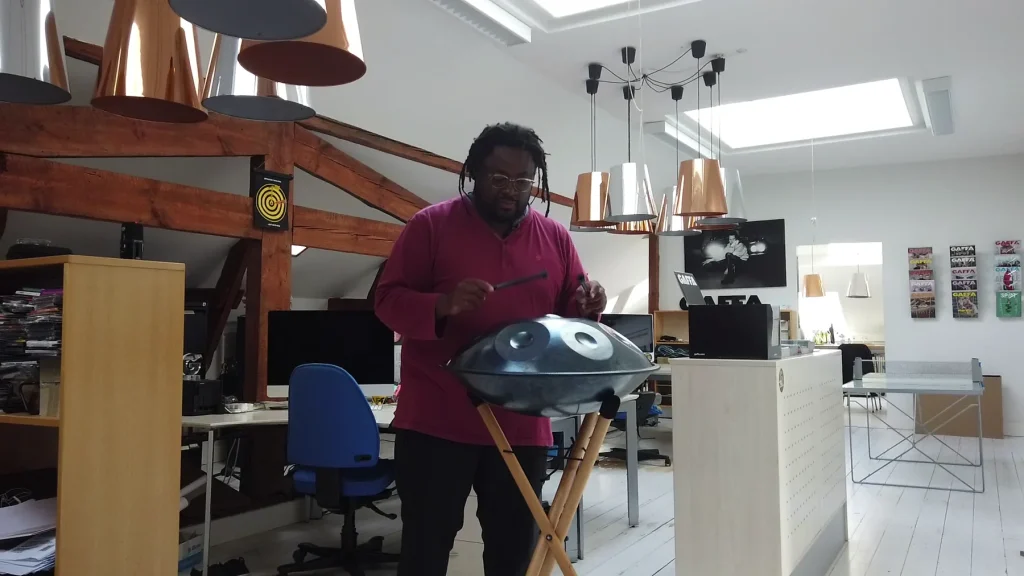
The handpan is a percussion instrument that has rapidly taken the music world by storm. Born in Switzerland in the early 2000s, it was created by Felix Rohner and Sabina Schärer. In just a few decades, this instrument has become an essential part of musical relaxation.
Its enchanting sound and wide range of notes arouse listeners’ curiosity. The history of this instrument is fascinating, combining innovation with a passion for music. It is a journey through time and space, from Swiss workshops to music stages around the world.
Understanding the importance of this instrument helps us appreciate its artisanal value and its role in contemporary music. In this article, we will explore the influences that shaped the handpan, its creation by visionary craftspeople, and its impact on well-being.
Introduction to the handpan: a fascinating instrument
The handpan is a captivating melodic percussion instrument. Often compared to a steel drum, this instrument produces musical notes when struck with the hands. Handmade, it is the product of exceptional craftsmanship.
With a diameter of approximately 50 centimeters, the handpan has a distinctive shape resembling a flying saucer. This unique design makes it easy to carry, which is ideal for musicians on the move.
The acoustic operation of this instrument relies on hammered indentations known as tone fields. These produce different notes, creating a complete musical scale on a single instrument.
Musicians can choose from three main types of scale: the major scale, which evokes joyful emotions; the minor scale, suited to mystical melodies; and the oriental scale, which recalls exotic atmospheres. Each choice offers a varied palette of emotions.
The handpan’s crystalline sounds and lingering vibrations captivate listeners, even those unfamiliar with music. This intuitive instrument allows beginners to create harmonious melodies from their very first attempts.
Every handpan is unique and made entirely by hand, giving it a distinct sonic personality. This authenticity is precious in a world dominated by standardized production.
What is the origin of the handpan? The instrument’s history and birth
The handpan, a unique percussion instrument, resulted from a fascinating collaboration among three musicians. Felix Rohner and Sabina Schärer, craftspeople at PANArt Hangbau AG in Bern, Switzerland, played a key role in its creation. They were joined by percussionist Reto Weber, who contributed his expertise and passion for music.
The origins of this instrument date back to the late 1990s. At the time, Rohner and Schärer were seeking to design an instrument inspired by the steel drum that could be played with the hands. They consequently created the Hang, distinguished by its crystalline, intimate sounds. Made from two sheets of nitrided steel, this instrument evolved into the handpan we know today.
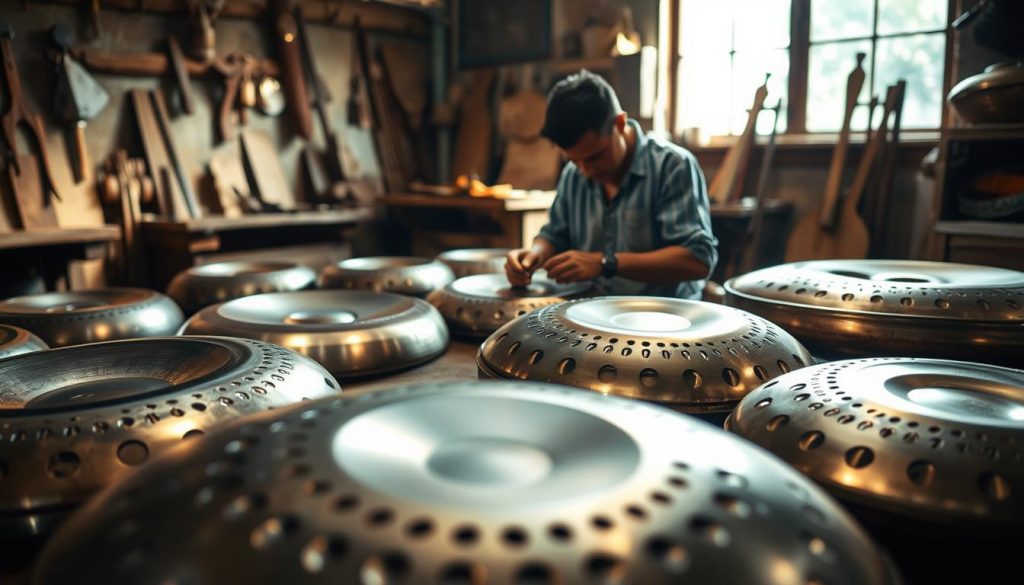
- A pivotal encounter: Felix Rohner and Sabina Schärer, both passionate about working with steel, founded PANArt and laid the foundations for a musical revolution.
- Reto Weber’s role: This percussionist helped turn the idea of a hand-played steel instrument into reality, blending percussion and melody.
- Creative context: In the late 1990s, Rohner and Schärer experimented tirelessly to create the first working prototype.
- Origin of the name: The word “Hang” comes from the Bernese German dialect and means “hand,” emphasizing the intention to create an instrument played solely with the hands.
- Evolution into the handpan: Over the years, improvements were made to refine the instrument’s sound quality and playability.
- PANArt’s strategy: The company initially sought to retain a monopoly on production before other makers responded to growing demand.
- Historical importance: This period marked a turning point in the history of contemporary music, as a small Swiss workshop gave birth to an instrument that would captivate the world.
The transition from the Hang to the handpan enabled this instrument to establish itself in genres ranging from world music to jazz. Its use also spread to relaxation and meditation practices, reaching an ever-growing audience.
To learn more about the impact and evolution of this instrument, read this article.
The major influences behind the handpan
The influences that shaped the handpan are as diverse as they are fascinating. Two key instruments had a particularly significant impact on its development: the Indian ghatam and the Caribbean steel drum. Each contributed essential elements to the handpan’s design and playing philosophy.
The influence of the Indian ghatam
The ghatam is an earthenware pot used in traditional Indian music. Its principle of being played with bare hands directly inspired the handpan’s design. This tactile connection allows musicians to express themselves intuitively.
The influence of the Caribbean steel drum
Originating in Trinidad and Tobago, the steel drum demonstrated that melodic instruments could be made from hammered metal surfaces. This approach was essential to the handpan’s creators, who combined the rhythmic richness of the ghatam with the melodic range of the steel drum.
This combination gave rise to a completely unprecedented hybrid instrument in the history of music. The handpan’s design also relies on technical innovations. One crucial development was a nitrided steel alloy enriched with nitrogen in its surface layer.
This innovation radically changed the metal’s mechanical properties, making it possible to obtain crystalline sounds of exceptional purity. The nitriding process increases the surface hardness while preserving the elasticity needed to produce harmonious, sustained vibrations.
Years of research and experimentation by craftspeople pushed the boundaries of handcrafted percussion-instrument production. The handpan consequently became the most iconic representative of a new family of steel instruments.
Handcrafting the handpan: where expertise meets technology
Creating a handpan is an art that skillfully combines tradition and innovation. Each instrument results from a painstaking process that blends artisanal expertise with modern techniques. Craftspeople choose high-quality steel sheets to ensure optimal resonance and durability.
Materials used: nitrided steel and its properties
Handpan makers favor nitrided steel for its strength. This material has specific mechanical properties that provide exceptional resonance. Its structure withstands the repeated stresses of hand playing, enabling it to produce rich, harmonious sounds.
Shaping, tuning, and finishing
Shaping handpans is a fascinating artisanal process. Each instrument is hammered by hand for hours to create its two hemispherical shells. The shells are then joined together to form the resonating chamber, which is essential to sound quality.
Once the shape has been created, tuning becomes crucial. Each note is produced by hammering specific areas of the steel. This forms tone fields that vibrate at precise frequencies and create a harmonious scale. This stage requires great precision and years of experience to master the art of tuning.
Finally, finishing techniques are applied to perfect the instrument. These include polishing the surface to remove imperfections and heat-treating it to stabilize the tuning. Protective coatings are sometimes added to prevent corrosion.
Every handpan is a unique work of art, with manufacturing variations that give it its own sonic personality. The quality of its design and construction is vital, because a poorly tuned instrument or one made from unsuitable materials will produce dissonant sounds, making the playing experience frustrating.
| Stage | Description |
|---|---|
| Material selection | Selection of high-quality nitrided steel for optimal durability and resonance. |
| Shaping | Hand hammering to form the hemispherical shells and create the resonating chamber. |
| Tuning | Precise hammering of specific areas to produce notes at defined frequencies. |
| Finishing | Polishing and heat treatment to stabilize the tuning and improve the appearance. |
The handpan’s worldwide spread and popularization
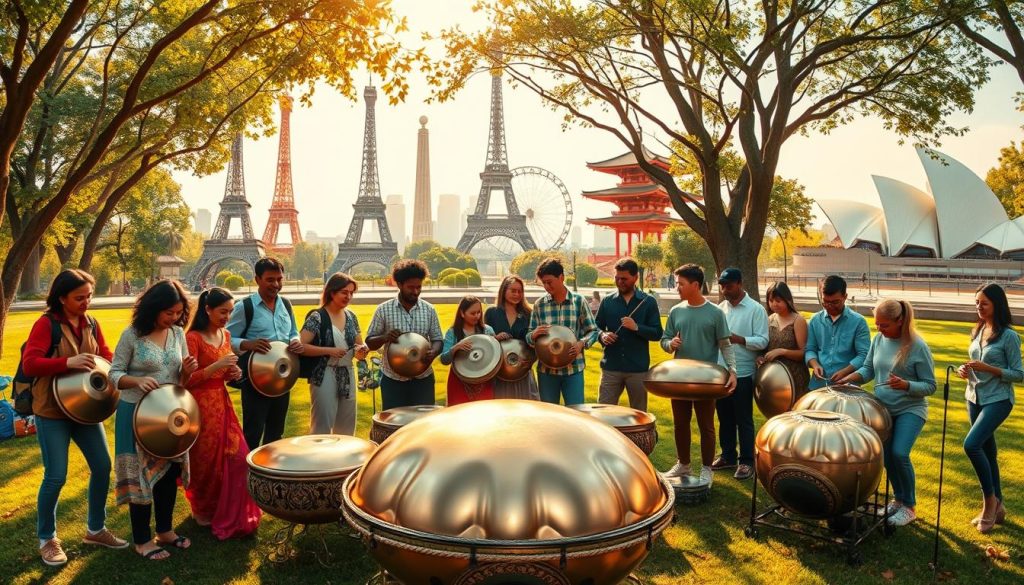
Since its creation, the handpan has spread impressively around the world. Fueled by musicians’ curiosity, this instrument has captivated an ever-growing audience. Street demonstrations, where passersby discover its enchanting sounds with wonder, have played a crucial role in this musical adventure.
Online recordings and social media have also played a decisive role in popularizing the handpan. Through these platforms, talented players share their performances with millions of listeners, inspiring others to take it up. This exposure has helped create a worldwide community around this unique instrument.
From Switzerland to musicians around the world
A major turning point came in 2013, when PANArt decided to stop producing the Hang. This decision opened the way for new manufacturers such as Meinl, Metal Sounds, and Sela. They seized the opportunity to develop their own ranges, making the handpan more accessible.
PANArt’s instruments had previously been rare and expensive. Prices changed with the arrival of new manufacturers. Entry-level instruments can now be found for between €1,000 and €1,500. This has allowed a much broader range of musicians to embark on their handpan journey.
The impact of PANArt ending production and the emergence of new manufacturers
What might have been seen as a serious setback for the handpan actually catalyzed its growth. Competition stimulated innovation and the instrument’s widespread distribution. Within ten years, the number of players soared, transforming a niche community into a worldwide musical movement.
Festivals, workshops, and gatherings devoted to the handpan sprang up, further strengthening this momentum. The handpan thus became a true musical phenomenon, bringing listeners and musicians from around the world together through its unique sounds.
The handpan in music and relaxation: a bridge between art and well-being
This captivating instrument plays an increasingly important role in music and relaxation. Its gentle sound and enveloping vibrations make it an ideal tool for meditation and music therapy. Many people are discovering the emotional and physical benefits of the handpan.
Use in music therapy and meditation
In music therapy, the handpan is used to create a sound environment conducive to relaxation. Players produce crystalline notes that flow slowly into one another, offering an immersive experience. These soothing sounds help release emotions and foster a state of inner calm.
Effects on mental health and stress reduction
The handpan’s effects on mental health are gaining recognition. The instrument’s harmonic frequencies slow the heart rate and reduce blood pressure. This encourages the production of alpha brain waves, which are often associated with states of deep relaxation.
Many health professionals, including hypnotherapists and sophrologists, incorporate the handpan into their protocols. They recognize its benefits for mental well-being. Moreover, learning this instrument encourages concentration and inspiration, contributing to the healing process.
- Exploring music therapy: The handpan’s gentle sounds create an ideal sound environment for relaxation.
- Meditation sessions: Players produce notes that guide the mind toward a state of mindfulness.
- Stress reduction: The handpan’s frequencies help slow the heart rate and reduce tension.
- Health professionals: A growing number of therapists are incorporating the handpan into their practices.
- Beneficial learning: The concentration required to play improves psychological balance.
- Immersive experience: The sound vibrations provide the sensation of an acoustic massage.
- A bridge between art and well-being: The handpan offers a sound experience that soothes the mind.
In short, the handpan is emerging as a genuine bridge between musical art and well-being. Whether for musicians or beginners, this instrument provides a transformative sound experience that soothes the mind while awakening artistic sensitivity.

Tips for choosing and buying a quality handpan
Before making a choice, it is crucial to consider several criteria when purchasing a quality instrument. A good handpan should be carefully selected according to its sonic characteristics and construction.
After deciding on the desired scale and number of notes, check that the instrument has no sonic interference. Excellent tuning is essential to avoid a frustrating experience for both players and listeners. Playing dynamics are also vital: the instrument should produce a rich sound even when touched lightly.
It is also important to consider the manufacturer’s reputation. Choose recognized makers such as Metal Sounds, Sela, or Meinl, which offer reliable instruments and good after-sales service.
Essential criteria: tuning, construction, and playing dynamics
When choosing a handpan, begin by checking its tuning. A poorly tuned instrument will make learning difficult and the music unpleasant. The notes should flow harmoniously into one another without unwanted sounds.
Construction is another key factor. A quality handpan should produce a harmonious sound even with a light touch of the hand. If you need to strike hard to obtain a good sound, this may indicate inadequate build quality.
Alternatives such as the tongue drum for limited budgets
If your budget is limited, consider the tongue drum as an alternative. This instrument, tuned to 432 hertz, offers a rewarding musical experience at a more affordable price. The main difference lies in the manufacturing method: a tongue drum is cut, whereas a handpan is hammered to create its characteristic dimples.
In summary, whether you choose a handpan or a tongue drum, it is essential to listen to several recordings before making your choice. Familiarize yourself with the different scales and, if possible, try several instruments in a specialist shop to find the one that resonates best with your musical sensitivity.
Conclusion
With its unique shape and enchanting sounds, the handpan represents far more than a simple musical instrument. It embodies a genuine connection between body and mind, transforming every note into a moment of grace. Whether you are a passionate musician or a beginner seeking serenity, this instrument offers a liberating sound experience.
This fascinating journey, traced throughout this article, highlights the handpan’s evolution from its modest beginnings in Switzerland to its status as an essential instrument in music and relaxation. Knowing the history of this instrument enriches our appreciation of its value, born of technical innovations and cultural influences.
In short, the handpan is both a sophisticated percussion instrument and an accessible meditation tool. It invites everyone to explore its music, immerse themselves in its vibrations, and join a growing community of enthusiasts. The handpan’s future looks promising, with new manufacturers and an expanding variety of instruments to discover.
For anyone wishing to embark on this musical adventure, read this article to learn more.