

The handpan is a fascinating instrument, created in 2000 in Bern, Switzerland. Designed to be accessible, it allows anyone, even without musical training, to create harmonious sounds within minutes. Its intuitive nature makes it an ideal choice for anyone wishing to explore music.
With notes that all belong to the same scale, this melodic and percussive instrument offers a unique experience. You do not need to understand music theory to start playing. Simply let your creativity speak.
In this guide, we will address the essential questions new players have: which model to choose, which scale to favor, and how to learn effectively. Get ready to discover a stress-free approach to the handpan, focused on feeling and improvisation.
Why choose the handpan when you are beginning to play a musical instrument?
The beauty of this instrument lies in its ability to make music accessible to everyone. Designed to eliminate complexity, it allows anyone to create melodies from the very first moments. This intuitive quality is especially appealing to people who have never played an instrument before.
One of the instrument’s main strengths is that it is tuned to a single scale. Every note is carefully selected to harmonize with the others, eliminating the risk of wrong notes. This means that even a novice can improvise pleasant sounds without worrying about playing out of tune.
“I am not a musician. Just an ordinary person in love with this instrument.”
An instrument designed for everyone
The handpan is ideal for non-musicians. Unlike instruments such as the violin or guitar, which require months of practice to produce a good sound, this instrument lets you improvise beautiful melodies during your very first session. It requires neither music-reading skills nor sheet music, making the learning process completely intuitive.
Benefits for non-musicians
Here are a few reasons why this instrument is perfect for beginners:
- Unique design: every note is harmonized, which eliminates wrong notes.
- Intuitive learning: no prior musical knowledge is needed.
- Rewarding experience: the instrument encourages players by producing immediate results.
- Accessible scales: scales such as D Amara and D Kurd are ideal for getting started.
The instrument’s Swiss creators wanted an ordinary person to be able to make music without technical barriers. This has a positive effect on motivation and enjoyment, allowing everyone to connect with music in a personal way.
To learn more about scales and playing techniques, read our article on how to play this instrument.
| Characteristics | Traditional instruments | Handpan |
|---|---|---|
| Tuning | Multiple scales, risk of wrong notes | One scale, no wrong notes |
| Ease of learning | Extensive practice required | Immediate and intuitive |
| Target audience | Experienced musicians | Everyone, including non-musicians |
In conclusion, the handpan is an instrument that encourages creativity and improvisation. It provides an enriching musical experience from the outset, making it a perfect choice for anyone who wants to explore the world of music without constraints.
How to choose your first handpan: scales, prices, and essential criteria
Choosing a musical instrument can seem intimidating, but the handpan offers a unique approach. This choice is crucial for new musicians because it shapes their musical experience. In this section, we will explore suitable scales, budget considerations, and advice for finding the right instrument for you.
Scales suitable for beginners
The most popular scale for getting started is D Kurd. It is balanced, expressive, and versatile, allowing you to create a wide variety of moods. Other appealing options include:
- D Amara: warm and almost impossible to play badly, it is often recommended as a first choice.
- D Sabye: open and neutral, perfect for a meditative sound.
- Onoleo: a gentle minor scale, ideal for anyone seeking an emotional quality.
- Ashakiran: an alternative worth exploring to broaden your musical possibilities.
Budget and quality
A high-quality handcrafted handpan generally costs between €1,000 and €2,500. Making this instrument requires great precision. It is important to be wary of very inexpensive models, as they may have tuning defects and a less richly developed sound. Such instruments are better regarded as an introduction than as a permanent choice.
Brands such as Yatao offer accessible, well-built handpans that are perfect for beginners. For example, Nala Sound Sculptures in Romania makes D Amara 9+1 models starting at €2,178.
Tips for selecting a handpan that suits your style
It is crucial to choose an instrument that inspires you. A handpan you enjoy will encourage you to play more often. Think about your musical style and aspirations. Read comparison guides such as “D Kurd vs. D Amara” to refine your choice.
| Scale | Characteristics | Approximate price |
|---|---|---|
| D Amara | Warm, versatile, difficult to play badly | €2,178 |
| D Kurd | Balanced, expressive, versatile | €1,500–€2,500 |
| D Sabye | Open, neutral, meditative sound | €1,200–€2,000 |
| Onoleo | Gentle minor scale, emotion without excessive depth | €1,000–€1,800 |
| Ashakiran | Interesting alternative, unique sound | €1,300–€2,300 |
In conclusion, choosing an instrument is an exciting step. Take time to discover the scales and models that appeal to you. With a little research and exploration, you will find the handpan that is right for you.
First steps: posture and playing technique for a good start
When you begin playing this instrument, posture and playing technique are essential. Good positioning will help you produce clear, harmonious sounds. Here is how to set yourself up correctly.
Positioning the instrument and your body
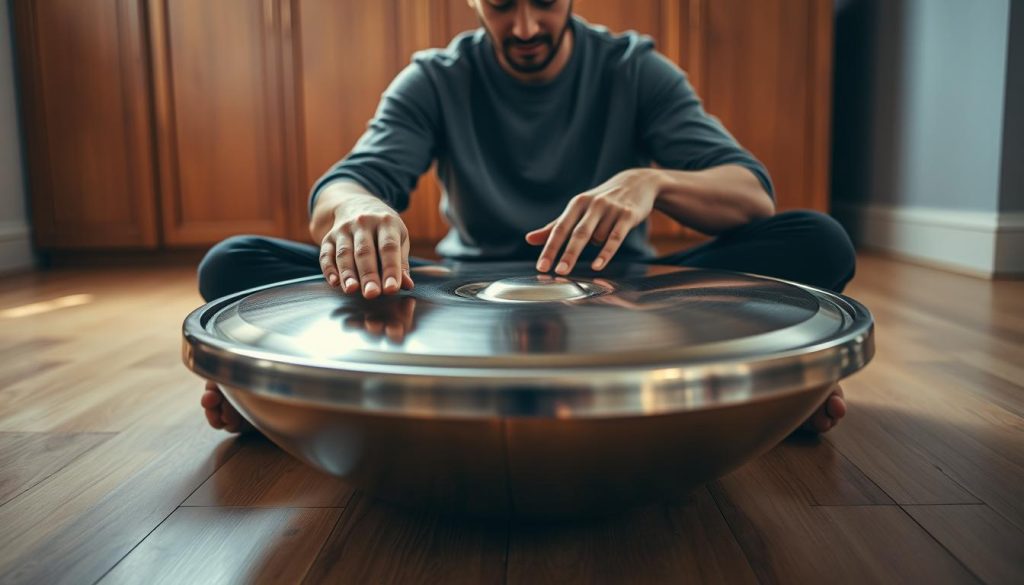
Sit on a chair or cushion with both feet flat on the floor. Rest the handpan flat on your lap, with the central Ding facing upward and positioned in the natural hollow between your thighs. Keep your back straight but relaxed and your shoulders loose, without hunching over the instrument. Let your arms hang freely from your shoulders.
Your hands should hover above the surface without pressing down on it. If you find yourself craning your neck to look at the notes, raise the instrument with a cushion underneath it or use a dedicated handpan stand. This will let you play comfortably, even while standing.
Finger-striking techniques: thumb, index finger, and middle finger
The handpan rewards the opposite of force. Imagine that every note is slightly too hot to touch. Strike and immediately lift your finger, allowing the fingertip to bounce off the steel so the note can resonate freely. Avoid pressing on the shell, as this can muffle the sound. Striking too hard can produce a dull “clonk” and may cause the notes to go out of tune over time.
Basic striking techniques include:
- Fingertip strike: use the pads of your index and middle fingers in a relaxed, quick motion, bouncing off the note.
- Thumb strike: used for the central Ding and sometimes for low notes, it produces a rounder, deeper tone.
- Alternating hands: once you are comfortable with a loop on a single note, begin alternating between your left and right hands.
A light touch for clear sound and good resonance
The fundamental principle of a light touch is crucial. Strike and lift your finger immediately to let the steel resonate freely. Pressing down muffles the sound, while light strikes create beautiful resonance. Avoid using sticks, hard mallets, rings, or your fingernails on the playing surface. Only soft mallets designed for this instrument should be used, to avoid marking the steel or knocking it out of tune.
For a practical exercise, begin by alternating hands on a single note until the movement feels natural. This alternation between the left and right hands will form the basis of all your future grooves.
| Technique | Description | Use |
|---|---|---|
| Fingertip strike | Using the pads of the index and middle fingers | Essential for most notes |
| Thumb strike | A strike intended for the central Ding and low notes | Produces a rounder sound |
| Alternating hands | Alternating between the left and right hands | Improves fluidity while playing |
By mastering these basics, you will be well equipped to explore the sounds and melodies this instrument can offer. Feel free to read our article on learning resources and exercises.
The basics of learning the handpan without stress or complicated theory
Learning a new instrument can seem complex. Yet with a relaxed approach, you can quickly become familiar with this instrument. The goal is to play without worrying about strict music-theory rules.
Exploring the notes and creating your first loops
To begin, do not rush into playing a piece. Take time to explore the sounds. Start by striking the central Ding with your thumb. Listen until it fades away completely: this is your reference note. Next, find the note directly above it and alternate slowly: Ding, note, Ding, note.
Add a note at the side to form a three-note loop. Repeat this sequence until it becomes automatic. Remember to change the rhythm while keeping the same notes. Leave silences and play two quick notes followed by one slow note. The magic of the handpan reveals itself in the space between the notes.
Close your eyes and maintain this loop for two minutes. This is often the moment when people fall in love with the instrument. You are already playing! Everything else—rolls, melodies, and nuances—grows from this simple loop.
Understanding the simplicity of the scales and not fearing wrong notes
One of this instrument’s great strengths is that all of its notes belong to the same scale. This means it is physically impossible to play a wrong note. It frees the beginner from the fear of making mistakes, which is essential for stress-free learning.
You do not need to know how to read music. With a progressive method, you can improve quickly. This will allow you to develop your musicality and create your own melodies.
Here are a few tips for getting the most out of your learning:
- Explore the notes freely, without pressure.
- Focus on rhythm rather than precise notes.
- Use learning methods such as online courses to guide you.
By following these steps, you will discover that playing this instrument is both accessible and rewarding. Remember that the most important thing is to enjoy every session.
| Element | Description | Benefits |
|---|---|---|
| Reference note | Central Ding | Makes orientation easier |
| Exploring notes | Alternating notes | Frees your creativity |
| Rhythm | Rhythmic variations | Enriches the musical experience |
Effective learning methods for beginners
Learning a new instrument can be an exciting adventure. To make the experience easier, learning methods are available that make the process both enjoyable and accessible. Modern resources allow you to improve quickly and at your own pace.
Using immersive video tutorials and playful notation
Immersive video tutorials are an excellent way to learn. MasterTheHandpan offers lessons filmed from above. This means your left side matches the teacher’s, eliminating any mental confusion. Each pattern is introduced progressively, making it easier to learn.
In addition, the innovative notation system uses symbols, colors, and numbers. These elements are designed to help beginners follow the lessons without needing to understand music theory. This lets students focus on the enjoyment of playing.
Following a step-by-step progression at your own pace
The MasterTheHandpan platform allows you to progress at your own pace. Every lesson is easy to follow, and you can track your progress over time. David Charrier, the teacher, shares his passion and makes every note feel intuitive and personal. This creates an enjoyable and motivating learning environment.
Supporting your learning with practical materials: e-books and printable exercises
In addition to the videos, an exercise booklet (e-book) is included. The booklet is printable, allowing you to continue practicing anywhere, even without an Internet connection. This gives you complete freedom in your learning.
With resources such as printable exercises, you can practice whenever it suits you. This reinforces your understanding and helps you master techniques more quickly.
Joining the MasterTheHandpan Academy gives you access to all existing courses as well as the new masterclasses offered each year. You will also become part of a private community where you can connect with other enthusiasts through live workshops, challenges, and webinars.
With more than 38,000 players trusting this method, you are not alone on your journey. There is also a 14-day money-back guarantee, allowing you to try it without risk.
Understanding and mastering rhythm: the essential driving force of handpan playing
Rhythm lies at the very heart of the music produced by this instrument. Even with a limited number of notes, a steady rhythm can create a pleasant, fluid melody. In his MasterTheHandpan tutorials, David Charrier teaches players how to approach pulse and subdivisions to maintain coherent playing.
Every instrument has a unique note layout. Understanding this structure transforms your playing experience. It allows you to compose, improvise, and play with intention. Once you understand how the notes interact, you no longer play at random but with genuine direction.
Learning pulse and rhythmic subdivisions
Mastering the pulse is essential. It helps you keep your playing steady without losing your place in the measure. Rhythmic subdivisions let you explore different dynamics and create captivating patterns.
Use a metronome when starting out. Begin at a slow tempo, then gradually increase the speed. This will help stabilize your rhythm and strengthen your muscle memory.
Creating simple patterns and developing your musicality
Begin with simple patterns by alternating your left and right hands. This will let you develop your musicality without pressure. Slow, repetitive loops are ideal for training your fingers and refining your technique.
Avoid hammering the notes like a drum. A light, bouncing touch is needed for the timbre to open fully. Spacious, well-timed playing sounds much better and helps the notes resonate.
By exploring different finger-striking techniques, you can enrich your rhythmic patterns. Use the pads of your fingers for higher notes and your thumb for lower notes and the central Ding. This adds variety to the sounds and greater depth to your playing.
In summary, understanding rhythm is crucial to getting the most out of this instrument. By incorporating these techniques, you will discover a new musical dimension. To deepen your knowledge, consult online learning resources such as this one.
Practical advice for improving quickly and enjoying yourself
When you begin playing this instrument, it is essential to focus on simple, effective habits. The best thing you can do is sit down with the instrument every day, even if only for five minutes. Consistency matters more than intensity. The handpan is a relationship to cultivate, not a skill to absorb in a rush.
Consistency is more important than intensity
One of the fundamental tips for new players is to prioritize consistency. Spending a few minutes playing each day will help you improve more quickly. It will help you form a connection with the instrument and develop your musical sensitivity.
Aim for sound quality, not speed
It is common to want to play quickly from the outset. However, speed looks impressive on YouTube, but slow, spacious playing sounds much better in your living room. By focusing on sound quality, you will develop a sensitive touch and beautiful resonance.
Avoid hammering the notes like a drum. The handpan requires a light touch so the timbre can open and resonate fully. Precise, repetitive playing is the key to mastering this instrument.
Varying rhythms and leaving space in the music
The silences and breaths between notes are just as important as the notes themselves. Varying the rhythms helps create a captivating musical atmosphere. Leave space in your playing: it will add depth to your music.
Remember that the handpan is designed for improvisation and deep listening. If the sound is beautiful and your hands are relaxed, you are playing well, whatever technique you use.
Explore different ways of playing and feel free to experiment with dynamics and nuances. Trust your own musical journey without comparing yourself with other players. Taking part in free beginner workshops, such as those offered by Handpan Facile, can also help you learn simple patterns and build a short piece in a supportive environment.
Handpan for beginners: how to get started and what to remember
Exploring this instrument means entering a rich and inspiring musical world. With a few simple basics and a little practice, you can quickly begin playing your first melodies. This instrument is designed to be accessible to everyone, without requiring the ability to read music or understand complicated theory.
Most models are made by specialist craftspeople, ensuring exceptional sound quality. Choosing the right scale can greatly influence your learning experience. Favor scales such as D Amara or D Kurd, which are forgiving and encourage creativity.
Here is a summary of the essential points for getting started:
- A unique instrument: designed to produce pleasant music within the first few minutes.
- Choosing a scale: select scales that inspire you musically.
- Posture and technique: adopt a relaxed posture with the handpan on your lap.
- Light touch: use the pads of your fingers to obtain a clear sound.
- Consistency: play every day, even for five minutes, to improve.
When it comes to learning methods, combining immersive video courses with playful notation is an excellent approach. Follow a step-by-step progression at your own pace and use practical materials such as e-books and printable exercises.
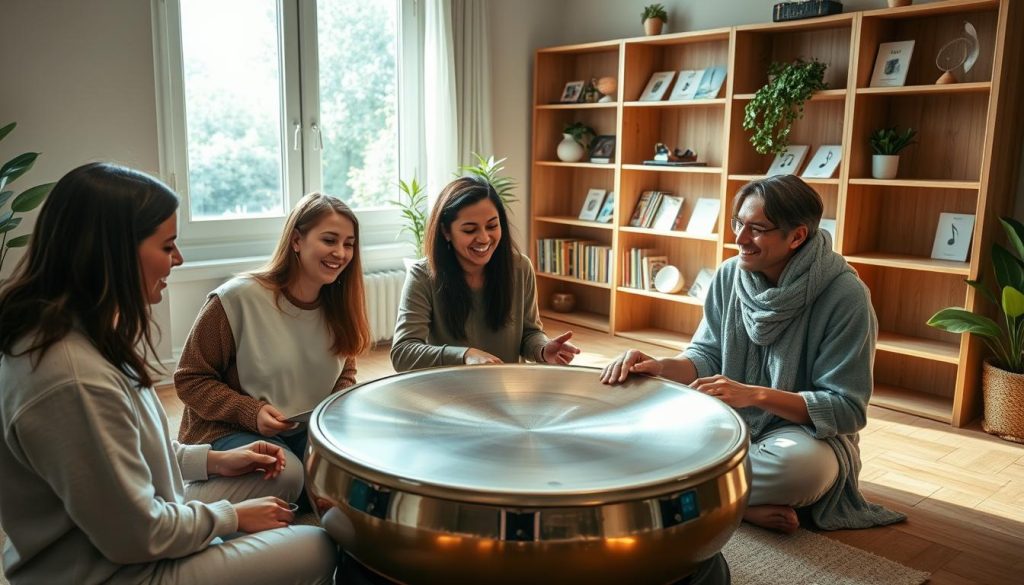
Finally, remember that the handpan is a relationship to cultivate over time. Enjoy exploring its sounds and listening deeply. Joining a community of enthusiasts can also enrich your musical journey. Feel free to share your experiences and ask questions.

Conclusion
The simplicity of this instrument allows everyone to express themselves musically, regardless of their experience. You will quickly discover that you can sound good much sooner than you imagine. The instrument does the difficult work by keeping you in key, leaving you free to focus on rhythm and listening.
To begin your journey, explore beginner-friendly instruments at specialist shops. Read guides on choosing your first model, or book a free session in Bucharest so you can try before you buy. The handpan is an instrument that lends itself very well to self-teaching, thanks to YouTube videos and learning by ear.
Embrace the instrument’s philosophy: intuitive, meditative learning. Every session is an exploration and a discovery. Feel free to join the growing community of enthusiasts and share your passion for this unique instrument.